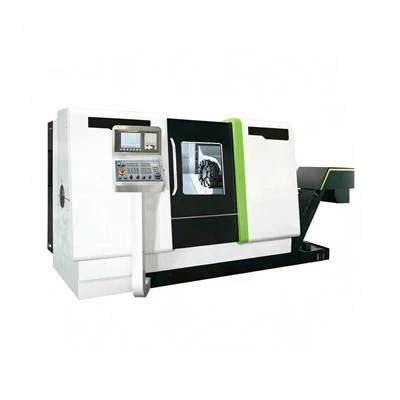
In the dynamic realm of manufacturing, the pursuit of enhanced machining efficiency stands as a constant quest for industry players. The advent of 5 - axis movement technology has emerged as a game - changer, revolutionizing the way we approach machining processes. As a leading supplier of 5 Axis Turning Centers, I have witnessed firsthand the transformative impact that this technology brings to the machining landscape. In this blog post, I will delve into the ways in which 5 - axis movement improves machining efficiency, offering insights into its advantages and real - world applications.
1. Reduced Setup Time
Traditional machining operations often require multiple setups to access different surfaces of a workpiece. Each setup not only consumes valuable time but also introduces the potential for errors due to re - clamping and alignment issues. The 5 - axis movement technology addresses these challenges by enabling the machining of multiple surfaces in a single setup.
With a 5 Axis Turning Center, the machine can tilt and rotate the workpiece or the cutting tool along multiple axes simultaneously. This means that complex parts with intricate geometries can be machined without the need for frequent re - positioning. For example, in aerospace component manufacturing, where parts often have complex contours and multiple access points, traditional machining might require several setups. But a 5 - axis machine can handle these parts in one go, significantly reducing the setup time. This reduction in setup time translates directly into increased productivity, as the machine spends more time in actual cutting operations rather than being idle during setup changes.
2. Enhanced Tool Accessibility
One of the primary benefits of 5 - axis movement is the improved tool accessibility to the workpiece. In a 3 - axis machining setup, the tool is limited to moving along the X, Y, and Z axes, which may restrict its ability to reach certain areas of a complex part. This limitation often results in the need for special tooling or complex fixtures.
However, 5 - axis technology allows the tool to approach the workpiece from virtually any angle. This increased flexibility means that the machine can use shorter and more rigid tools, which are less prone to deflection and can achieve higher cutting speeds and better surface finishes. For instance, when machining a turbine blade, a 5 - axis machine can access the curved and angled surfaces directly, eliminating the need for multiple passes or complex tool paths that would be required in a 3 - axis setup. This enhanced tool accessibility not only improves the quality of the machined part but also speeds up the machining process.
3. Improved Surface Finish
The ability of 5 - axis machines to maintain a constant cutting angle and optimize the tool path has a profound impact on the surface finish of the machined part. In traditional machining, changes in the cutting angle can lead to uneven material removal, resulting in a rough surface finish.
In a 5 - axis machining process, the machine can adjust the orientation of the tool and the workpiece in real - time to ensure a consistent cutting angle throughout the operation. This consistent cutting action reduces the formation of tool marks and chatter, resulting in a smoother surface finish. For example, in the production of high - precision molds, a 5 - axis machine can achieve a mirror - like surface finish without the need for extensive post - machining polishing. This not only saves time but also reduces the cost associated with secondary finishing operations.
4. Higher Precision and Accuracy
Precision is a critical factor in machining, especially in industries such as automotive and medical device manufacturing. The 5 - axis movement technology offers superior precision and accuracy compared to traditional machining methods.
By allowing the machine to approach the workpiece from multiple angles, 5 - axis machining can minimize the effects of geometric errors. For example, in a 3 - axis setup, errors in the alignment of the workpiece can accumulate over multiple operations, leading to significant dimensional inaccuracies. In contrast, a 5 - axis machine can correct for these errors by adjusting the tool path and orientation in real - time. This real - time adjustment ensures that the final part meets the exact design specifications, reducing the scrap rate and improving overall production efficiency.
5. Complex Part Machining
The manufacturing industry is constantly evolving, with an increasing demand for complex parts with unique geometries. 5 - axis movement technology is ideally suited for machining these complex parts.
Whether it's a part with undercuts, internal features, or complex curved surfaces, a 5 Axis Turning Center can handle it all. For example, in the production of dental implants, which have complex screw - like shapes and precise internal features, 5 - axis machining can produce these parts with high accuracy and efficiency. This ability to machine complex parts in a single setup not only saves time but also enables manufacturers to take on more challenging projects and expand their product offerings.
Real - World Applications and Case Studies
To further illustrate the benefits of 5 - axis movement in improving machining efficiency, let's look at some real - world applications.
Aerospace Industry: The aerospace industry demands high - precision components with complex geometries. 5 - axis machining is widely used in the production of aircraft engine components, such as turbine blades and impellers. These parts require a high degree of accuracy and surface finish, and 5 - axis machines can meet these requirements efficiently. For example, a leading aerospace company reduced the production time of a critical engine component by 40% after switching to 5 - axis machining, thanks to the reduced setup time and improved tool accessibility.


Automotive Industry: In the automotive industry, 5 - axis machining is used for manufacturing high - performance engine parts, transmission components, and custom automotive parts. The ability to machine complex parts in a single setup allows automotive manufacturers to increase production speed and improve product quality. For instance, a car manufacturer was able to reduce the cost of producing a custom - designed engine block by 30% by using a 5 - axis machine, as it eliminated the need for multiple machining operations and reduced the amount of scrap material.
Related Product Offerings
As a 5 Axis Turning Center supplier, we also offer a range of other high - quality CNC machine tools to meet the diverse needs of our customers. Here are some of our featured products:
- Large CNC Lathe: Ideal for machining large - sized workpieces with high precision and efficiency.
- Double - column Vertical Lathe with Tool Magazine: This machine offers enhanced stability and tool - changing capabilities, suitable for heavy - duty machining operations.
- 5 Axis Gantry CNC Machine: Designed for large - scale machining projects, providing high - speed and accurate 5 - axis machining.
- Machine Tool with Linear Guideways: The linear guideways ensure smooth and precise movement, improving the overall machining performance.
- Horizontal Lathe with Slant Bed: A versatile lathe with a slant bed design, offering improved chip evacuation and cutting stability.
Conclusion
In conclusion, the 5 - axis movement technology has revolutionized the machining industry by significantly improving efficiency in multiple ways. From reducing setup time and enhancing tool accessibility to improving surface finish and enabling complex part machining, the benefits are undeniable. As a supplier of 5 Axis Turning Centers, we are committed to providing our customers with the latest and most advanced machining solutions.
If you are interested in improving your machining efficiency with 5 - axis technology or any of our other CNC machine tools, we encourage you to reach out to us for a procurement discussion. Our team of experts is ready to assist you in selecting the right machine for your specific needs and to provide you with comprehensive support throughout the procurement process.
References
- Smith, J. (2020). "Advances in 5 - Axis Machining Technology." Manufacturing Technology Journal.
- Brown, A. (2019). "The Impact of 5 - Axis Movement on Machining Efficiency." Industrial Manufacturing Review.
- Johnson, R. (2021). "Case Studies in 5 - Axis Machining Applications." Precision Engineering Magazine.