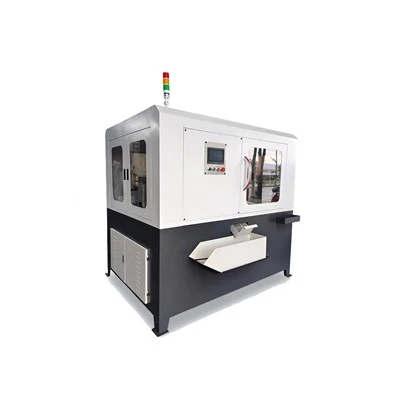
The concept of an automatic grooving machine immediately brings to mind the precise and efficient creation of grooves on various materials. Typically, we associate these machines with straight, linear grooves, as they are straightforward to execute and highly common in industrial applications. However, a fascinating question often arises: Can an automatic grooving machine process curved grooves? As a leading supplier of automatic grooving machines, I'm here to delve into this matter in detail.
The Basics of Automatic Grooving Machines
To begin with, let's understand what an automatic grooving machine is. An automatic grooving machine is a sophisticated piece of equipment designed to cut grooves into different workpieces with high precision and repeatability. It operates based on pre - programmed instructions, which control the movement of the cutting tool and the workpiece. These machines are widely used in industries such as metalworking, woodworking, and plastics manufacturing.
The standard operation of an automatic grooving machine involves moving the cutting tool along a linear path to create grooves of a specific width, depth, and pitch. This linear movement is relatively easy to control, as it can be achieved through simple linear actuators and motion control systems. The machine's software ensures that the cutting process is consistent, and the grooves are of high quality.


Challenges in Processing Curved Grooves
Processing curved grooves presents a set of unique challenges compared to straight grooves. One of the primary difficulties lies in the complexity of motion control. Unlike linear motion, curved motion requires the cutting tool to follow a non - linear path. This demands a more advanced motion control system that can accurately calculate and adjust the tool's position and orientation at every point along the curve.
Another challenge is the cutting force. When cutting a curved groove, the cutting force varies continuously due to the changing direction of the tool's movement. This can lead to uneven cutting, tool wear, and even damage to the workpiece. To overcome this, the automatic grooving machine needs to be equipped with a powerful and stable cutting mechanism that can adapt to the changing cutting forces.
Technological Solutions for Curved Groove Processing
Despite the challenges, modern technology has provided several solutions for processing curved grooves with an automatic grooving machine.
Advanced Motion Control Systems
Today's automatic grooving machines can be integrated with advanced motion control systems, such as 3 Axis Cartesian Robot or Gantry Style Robot. These robots can move the cutting tool along complex three - dimensional paths, including curved trajectories. They use high - precision sensors and servo motors to ensure accurate positioning and smooth motion.
The software that controls these robots is also crucial. It can generate the necessary motion profiles for the curved grooves based on the design specifications. The operator simply needs to input the curve's parameters, such as radius, arc length, and center point, and the software will calculate the optimal path for the cutting tool.
Adaptive Cutting Technology
To deal with the varying cutting forces during curved groove processing, adaptive cutting technology can be employed. This technology continuously monitors the cutting force and adjusts the cutting parameters, such as feed rate and spindle speed, in real - time. For example, when the cutting force increases, the feed rate can be reduced to maintain a stable cutting process. This not only improves the quality of the curved grooves but also extends the life of the cutting tool.
Applications of Curved Grooves
The ability to process curved grooves with an automatic grooving machine opens up a wide range of applications.
Automotive Industry
In the automotive industry, curved grooves are often required for components such as engine blocks, transmission parts, and brake discs. These grooves can improve the performance and durability of the components. For example, curved grooves on a brake disc can enhance the heat dissipation and reduce the risk of brake fade.
Aerospace Industry
The aerospace industry also benefits from curved groove processing. Components such as turbine blades and aircraft frames may require curved grooves for aerodynamic or structural purposes. The high precision and repeatability of an automatic grooving machine ensure that these components meet the strict quality standards of the aerospace industry.
Our Company's Offerings
As a supplier of automatic grooving machines, we are at the forefront of providing solutions for curved groove processing. Our machines are equipped with the latest motion control systems and adaptive cutting technology, enabling them to process curved grooves with high precision and efficiency.
In addition to our automatic grooving machines, we also offer a range of complementary products, such as Automatic Loading and Unloading Machine, Automatic Drilling and Tapping Machine, and Auto Turning Machine. These products can be integrated into a complete production line to further enhance the manufacturing efficiency.
Contact Us for Procurement
If you are interested in our automatic grooving machines or have specific requirements for curved groove processing, we encourage you to contact us. Our team of experienced engineers and sales representatives is ready to provide you with detailed product information, technical support, and customized solutions. We are committed to helping you achieve your manufacturing goals with our high - quality products and excellent service.
References
- "Modern Machine Tool Technology" by David A. Dornfeld.
- "Motion Control Handbook" by Brian H. Cowan.
- Industry reports on metalworking and manufacturing technologies.